Impressions

Showing posts with label Hacking. Show all posts

Tuesday, February 22, 2011

Hackaday links: February 21, 2011

PCB Stand

Part PCB, part old IC, and held together with hot glue. It doesn’t take much to make this electronics stand, but it’ll certainly add to the geek level of your desk.

Decorate with light


This busy living room is actually decorated all in white. The patterns that give it life are on lend from a projector and what we’d imagine is some fantastic software. [Thanks MDV]

Flashing butt on your bike

[Eli] sewed lights and flex sensor into her jeans. Now her butt flashes in heart-shaped patterns as she rides. She actually robbed one of the flex sensors from this project to complete that explosive high-five project.


Mini-rake’s progress


A lathe and some sand that needs tending is all that [Spatula Tzar] needed to get this zen garden rake under way. We like how she used a vacuum bag to infuse the wood

Paper and electron


This collection of musical projects forsakes common substrates and builds the mess of circuit boards on pieces of paper. Not much information but the strangeness is worth a look.

DIY emergency lighting system


When the power goes out at home, what do you do? Most of us probably scramble around the house looking for a flashlight. [Gigawatts] wanted a better solution, so he built an emergency lighting system based off a standard household UPS. A while back he had constructed a relay-switched outlet box to help periodically restart his cable modem which would get hung up a little too often for his liking. Since changing Internet providers, he no longer needed the switched outlet box, and was looking for a way to reuse it.

He hooked up the outlet box into the “battery powered” side of the UPS, and inserted a light bub into the normally closed half of the switch box. A 5v power supply was hooked into the “surge protection only” side of the UPS and is used to keep the relay switched. This causes the half of the switch box that is normally closed to remain open, and the light switched off. When power is lost, the 5v supply no longer switches the relay, and the light is turned on – powered by the UPS battery.

This is quite a useful hack if you happen to have a spare UPS sitting around – it sure beats scrambling around searching for a flashlight in the dark!

NES game pad wireless light commander


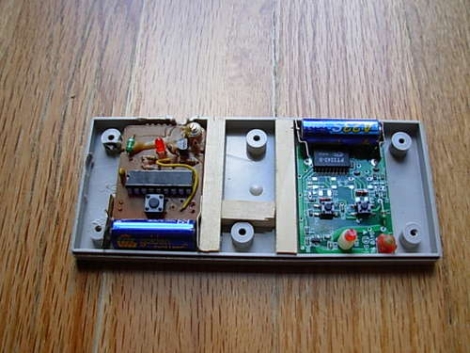
Annoyed that the new lights he bought for his apartment lacked power switches, Instructables user [p.arry.drew] decided to install a pair of wireless light switches. Not content to use the remotes separately, he decided to see if he could cram them both into an old NES controller, making for a nice all-in-one wireless light commander.

He disassembled the light switch remotes, cutting off a bit of the battery contacts to ensure they fit in the game pad. He then pulled apart his NES controller, removing the cord and adding some foam padding to ensure that the buttons fully contacted the wireless switches when pressed. A few bits of wooden dowel were added to keep everything in place, then the controller was reassembled.

His creation makes for a very convenient method of controlling several light switches from once source, plus the packaging is pretty handsome as well. These remote light switching solutions seem to be all the rage lately, so keep them coming!

Read on for a quick video of his remote light switches in action.

http://www.youtube.com/watch?feature=player_embedded&v=0SifRm_Ju8E

Ultrasmall Arduino


[Fabio Varesano's] new Arduino compatible board packs a full power punch in a ultra compact layout, measuring at 20.7×15.2 mm, the Femtoduino is probably the smallest 328 based Arduino compatible board around. Most of the staples are present, an QFN atmega328, an MIC5205 low dropout regulator good for a couple hundred milli amps, 16MHz ceramic resonator, reset, power indicator and pin 13 LEDs, but you will need to provide your own serial connection (FTDI, MAX232 etc) and another AVR programmer to get the Arduino boot loader onto the chip.

Since the board is small (smaller than a pro mini) it is not directly breadboard friendly. Even though the hole spacing is 0.05 inch, the size is large enough for “normal” wire to fit into fine, if you wish to use 0.1 inch spacing there is a handy break out board you can make where the Femtoduino just snaps in.

Everything needed to make one of your own is provided on the website, schematics, kicad files, bill of materials, Gerbers for both the board and the breakout board, though we would like to see this as a pre-made board soon, join us after the break for a video and see why.

http://www.youtube.com/watch?feature=player_embedded&v=w-TVLYRprAI

Farmbot


Prospero is the working prototype of an Autonomous Micro Planter, which is intended to be unleashed as a swarm. Using a Parallax propeller mounted on a Lynxmotion AH3-R hexapod body, though we have a ton of different ideas on hexapods if you find the price of the body to be out of budget.

Inputs to the machine are pretty standard robot fare like infrared, and ultrasound. Outputs on the other hand are more interesting, for example spray paint, retractable drill, seed dispenser, and of course a stack of servos.

Arming a robot with a drill and a can of spray paint sounds like a recipe for hours of fun, but it does have a job to do. Walking around, the bot stops and checks the ground below it, and if the ground is ok to seed, a small auger drill flips down from the robot’s belly. After drilling a hole, a seed is dropped, then covered over with a scoop on the back of the drill. Finally the seeded the spot is marked with white paint and the robot moves on.

Though its a prototype and not fully formed yet, its an interesting thing to see, so join us after the break for a video.

http://www.youtube.com/watch?feature=player_embedded&v=ACtihXjq2B0

Interfacing an Arduino with a TFT LCD


Seven-segment displays and monochrome LCDs are fine for most projects, but some things simply look better in color. [John] over at the Little Bird Electronics blog recently wrote up a tutorial demonstrating the use of a TFT LCD panel with an Arduino. The specific panel he chose was a 4D Systems 1.44” TFT LCD that happened to feature a dedicated graphics processor, which should allow for some fantastic visuals when used to its fullest potential.

The LCD takes its commands over a serial interface, making it a simple five-wire display solution for your projects. The display can be programmed manually by sending hex commands over the serial interface, but there are also some user-developed libraries available that will allow you to use the majority of the most popular functions without the learning curve. One thing to note is that the LCD must be flashed with a particular flavor of firmware before it can communicate over the serial interface, a process for which [John] provides a walk through.

The LCD panel can be used with any Arduino-compatible board, so it can be useful in a whole host of projects.

Stick around to see a simple demo of the board in use.


Video

http://www.youtube.com/watch?feature=player_embedded&v=BKy-GuKWGZ8

Amazing backyard rocket ship tree house


If you thought you had a cool tree house as a kid, think again. Tasked with landscaping his back yard and building a tree house for his son, [Jon] decided to go all out and build him a rocket ship instead.

Rising 15 feet into the Seattle skyline, the tree house known as the Ravenna Ultra-Low-Altitude Vehicle (RULAV), is sure to be the envy of every kid in the neighborhood. [Jon] and a friend worked for well over a year on their creation, welding, grinding, painting, and riveting their way along. After the structure was built, they fabricated some custom PCBs, using them to build the ship’s 14 control panels. The entire operation is controlled by a custom OS built to run on the three ATmega MCUs that manage operations.

Not content with just a handful of knobs and switches, the ship contains over 800 LEDs among its laundry list of electronics goodies. Compressed air is used to shoot water from positioning “thrusters”, while a paint mixer spins under the ship to simulate the rough and bumpy nature of space travel. The simulated launches are capped off with plenty of authentic NASA-style audio and a sub woofer that gives everything a deep, resonating rumble.

The project is truly amazing, and a ton of work went into every little detail in order to make this the most spectacular tree house ever seen. [Jon] definitely takes the award for “Coolest Dad Ever” for this build, even we’re jealous!

The pictures certainly don’t do it justice, so be sure to check out the video below for a quick introduction and demo of this awesome project.

Thanks to [Jeremy Elson] for the tip.

Video

http://www.youtube.com/watch?feature=player_embedded&v=8izMrzulMHI

Over-engineered clock finds purpose as RSS reader


[Bob Alexander] admits that he over-engineered his clock, giving it eight control buttons, eight twelve-segment alpha-numeric display digits, a GPS module as a time source, and a beefy microcontroller to boot. But he’s found a way to get more for his money out of the device by adding RSS and weather features to it.

Since he’s using the PIC 18F4550 it’s a snap to add USB connectivity. From there he wrote a fantastic PC-side application for communicating with the display. Now he has the option of displaying time, RSS feeds, or weather by scrolling through the options with one of the buttons. Perhaps the best feature is the option to launch a browser on the PC and view the current story just by pressing a button on the display. Check out the two demos after the break; one shows the clock features and the other demonstrates the C# software.

Video
http://www.youtube.com/watch?feature=player_embedded&v=PrWVMo_Bmfs

DIY pick and place seems easy to build


We’re not saying it’s a simple project, but the build methods that [Alan Sawula] used for this DIY pick and place are probably the easiest we’ve seen yet. As this is just a CNC machine, the methods he used would also work quite well for mills or other machines. Instead of using precision rods for the X and Y axes, he used square tubing. The tubing is oriented more like a diamond, with the ninety degree corners providing the travel surface. Two bearings with a shim between them provide a groove that rides along the corner, and since this is square and not just ‘L’ bracket, the sleds are secured both above and below the tube. Stepper motors provide the movement along X and Y, with a servo motor for Z and another one to rotate the medical grade needle that serves as the vacuum tip. Starting four minutes into the video you can see that this not only works, but it’s lightning fast!
Video
http://www.youtube.com/watch?feature=player_embedded&v=BoCJFJsCXPQ

Plug-in module lies about news at coffee shops. Real or Fake?


[Mike] sent in a tip about Newstweek, and we’re turning to our readers to tell us if this is real or if we’re being trolled. The link he sent us points to a well-written news-ish article about a device that plugs into the wall near an open WiFi hotspot and performs something of a man-in-the-middle attack on devices connected to the access point. The article describes the device above as it observes, then spoofs the ARP table of the wireless network in order to inject fake news stories in pages you are reading. Apparently once it boots, the small box phones home for commands from its maker over a TOR connection.

The box reminds us of the Sheevaplug so it’s not the hardware that makes us question the possibility of the device. But look at the Linux terminal screen readout. It shows a prompt with the word ‘newstweek’ in it. That’s the address of the site the article is hosted on, giving us a strong sense of being trolled.

What do you think, real or fake? Let us know (and why you think that) in the comments.

RF control from just about any device


[Mirko] is working on a library that will allow you to add RF control to just about any device. The only requirement is that the device be capable of running a Linux kernel, and that it have a few GPIO pins available. One example is fairly straight forward, a Netgear router. Many, if not most routers run a Linux kernel natively and most have solder points on the board for unused IO pins so patching into the hardware is very straight forward. Less obvious and much more impressive is the hack seen in the image above. [Mirko] built an SD card adapter cable and uses the contacts in the card reader

Saturday, February 19, 2011

'Supply of Ethical Hackers in India Short of Demand' Future of Ethical Hackers


This has very much to do with the nation’s security, but not one that the political leadership is being pulled up for. As hackers from across the border in Pakistan mount a cyber attack against the country’s websites, Indian hackers seem to be falling considerably short in firepower.

"In the ongoing cyber warfare between the two countries, roughly 40-50 Indian sites are being hacked on a daily basis by Pakistani hackers while bout 10 Pakistani sites are being hit by their Indian counterparts”, says Ankit Fadia, Mumbai-based ethical hacker and an expert on cyber crime.

Mr Fadia is clear that breaking into foreign country’s websites does not fall within the realm of ethical hacking, but mentions how Pakistanis outdo Indians in hacking to underline India’s reactive, rather than proactive, approach to hacking issues.

He says the attitude of the corporate sector towards cyber security is almost as laid back as that of the government agencies, with the result that ethical hacking is still at a low key across the spectrum. Ethical hackers, who also go by names such as white hackers, white knights or sneakers, are computer security experts who specialise in penetration testing and related testing methodologies to check the vulnerability of a company’s information systems.

Nasscom surveys have pointed out that information security threats have created an "unprecedented demand for qualified and experienced information security professionals”, but Mr Fadia reckons that the supply of ethical hackers in the country is far short of the demand of corporates and government agencies.

"Ethical hacking does come with a cost, but it is not prohibitively expensive, either. But often, corporates appreciate the need only after a security breach happens”, Mr Fadia told ET.

According to him, social networking sites have become hackers’ favourite hunting grounds these days, marking a clear break from the e-mail route to passing on a virus.

Ethical hacking communities are operating in the country but Mr Fadia says a strong and serious community operation of ethical hackers is virtually absent in the country.

Researchers spy on BitTorrent users in real-time {User Uploads and Downloads Revealed}


Researchers have devised a way to monitor BitTorrent users over long stretches of time, a feat that allows them to map the internet addresses of individuals and track the content they are sending and receiving.

In a paper presented earlier this week at the Usenix Workshop on Large-Scale Exploits and Emergent Threats, the researchers demonstrated how they used the technique to continuously spy on BitTorrent users for 103 days. They collected 148 million IP addresses and identified 2 billion copies of downloads, many of them copyrighted.


The researchers, from the French National Institute for Research in Computer Science and Control, also identified the IP addresses where much of the content originated. They discovered the the vast majority of the material on BitTorrent started with a relatively small number of individuals.

"We do not claim that it is easy to stop those content providers from injecting content into BitTorrent," they wrote. "However, it is striking that such a small number of content providers triggers billions of downloads. Therefore, it is surprising that the anti-piracy groups try to stop millions of downloaders instead of a handful of content providers."


The researchers said the information leak is built in to the very core of most BitTorrent systems, including those used by ThePirateBay and IsoHunt. They support commands such as "scrape-all" and "announce started/stopped," which when used repeatedly can be used to identify the IP addresses where content originates or is being distributed once it has proliferated.

By collecting more than 1.4 million unique .torrent files, they were able to identify specific pieces of content being distributed by particular IP addresses. The results are about 70 percent accurate.

"At any moment in time for 103 days, we were spying on the distribution of between 500 and 750K contents," they wrote. "In total, we collected 148M IP addresses distributing 1.2M contents, which represents 2 billion copies of content."

The insecurities baked into BitTorrent allowed the researchers to discover IP addresses even when they were hidden behind the Tor anonymity service. It should be pointed out that this isn't the fault of Tor, which has long urged people to refrain from using BitTorrent over the virtual privacy tunnels. In light of the new research, project managers renewed that admonition on Thursday.

"The BitTorrent protocol is vulnerable to tampering by malicious parties," Jacob Appelbaum, a full-time developer for Tor volunteer wrote in an email to El Reg. "This is not so different than when you're using Tor or on any other internet connection. If someone wants to tamper, there's nothing in the protocol to stop the tampering."

A PDF of the paper is here. ®

Source:-www.theregister.com

Cyber Crime: Man held for e-mailing threats to hotel


A 40-year-old man who had sent e-mail threats to a city hotel in his wife’s name, in order to create trouble for her, was arrested by the cyber cell of the Pune police on Thursday.

Sunil Suresh Nayak alias Suresh Dholkya (40) was nabbed in Bangalore by a police team led by deputy commissioner of police (cyber cell) Rajendra Dahale.

Speaking to reporters, Dahale said that Nayak had sent two e-mails to the hotel on June 1 and in them he had threatened to blow up the hotel on June 2. He also told the hotel to pay Rs 2.5 crore through a bank demand draft and gave his wife’s address so that the payment could be made. "We received a complaint on June 1 from the hotel authorities,” Dahale said.

The police contacted the networking website to find out where the e-mail had come from. "The company gave us the address, which turned out to be a cyber cafe in Bangalore,” said Dahale.

"Our team went to Bangalore and checked the hard discs of the computers at the cyber cafe,” added Dahale. "We confirmed that the e-mails had indeed been sent from one of the computers. The cafe owner told us that one particular person used that computer every day.”

The police led a trap near the cafe and arrested Nayak on Thursday. "After the arrest he immediately admitted to sending the e-mails to the Pune hotel,” said Dahale. "He also admitted to sending insulting e-mails to the cyber cell of the Mumbai police.”

During interrogation Nayak said that he had sent the e-mails to create trouble for his wife. According to him, he and his wife were doing HR consultancy in Singapore. "On the pretext of selling some property in Bangalore, my wife brought me in India. She registered a complaint of harassment against me and I was put in prison for 20 days,” Nayak said.

He said that his wife had also thrown him out of the house. "I was depressed and wanted to teach her lesson. So I created a fake e-mail address, randomly selected a hotel in Pune and sent e-mails to the hotel,” Nayak said.

Dahale said that Nayak has been arrested under section 66 (a) and 66 (c) of Information and Technology Act.

Garage Monitor Has an Extra Arduino


[Jody] wanted to know when his garage door was open. He details his setup which uses a temperature sensor read by an Arduino to send over XBee radio to a computer running a Windows Service. We have seen this twice before, and is noteworthy as a lesson. The XBee radios have the ability to read analog data, relay digital signals, and a lot more. This means the Arduino is completely unnecessary. For example, the Tweet-a-Watt uses two of an XBee’s ADCs to measure voltage and current in a Kill-a-Watt power meter. Programming an XBee is really simple, with the help of tutorials from SparkFun and Adafruit. A bit of programming and soldering should get [Jody] back his Arduino. We hope this note will help you find more creative uses of XBees without microcontrollers.

Friday, February 18, 2011

Bringing the Shark to the Bee


Wireshark, a tool recognized universally as being one of the best network analyzers available, has long been used by legitimate network professionals as well as a shadier crowd (and everywhere in between). While useful for analyzing both wired and Wi-Fi traffic, monitoring 802.15.4 protocols (such as Zigbee) have not been a common use in the past. [Akiba] of FreakLabs has brought us a solution which works around the normal limitations of Wireshark’s libpcap base, which does not accept simple serial input from most homebrew setups that use FTDI or Arduinos to connect to Zigbee devices. Using named pipes and a few custom scripts, [Akiba] has been able to coax Wireshark into accepting input from one of FreakLabs Freakduino boards.

While there are certainly professional wireless analyzing tools out there that connect directly into Wireshark, we at Hackaday love showing off anyone who takes the difficult, cheap, out of the way method of doing things over the neat, expensive, commercial method any day.

Nokia internet key external antenna


[Maurizio] was having some reception issues with his wireless internet and set out to add an external antenna to the USB dongle (translated). He had previously poked around inside of the Nokia internet key to find that the internal antenna was a flexible circuit substrate wrapped around a plastic box that made contact with main circuit board via a spring connector. This plastic frame is just right for mounting an SMA connector in just the right place for it to stick out the end of the case as seen in the picture above. It gives him better range, but since speed depends on how much traffic the wireless node is under, it’s not a guarantee that you’ll get a snappier connection after this hack.

The pirate box


One of the most fun aspects of a LAN party was exploring the shared files of all the other users on the network. There were people that would show up, solely for the file swapping. That is exactly what this project is about. From the projects wiki, the Pirate box is a mobile p2p sharing and collaboration platform. Basically it is a wireless hotspot with a slick interface and a shared folder. It doesn’t connect to the internet, and it doesn’t log any connections. You can have a file swapping session simply by flipping it on and sharing its space with other people. They’ve included a step by step guide to setting up your own, but if you’re going to do some subversive file swapping we might suggest putting it in a less conspicuous enclosure. Imagine this as a portable verion of dead drops.

Wireless electricity enables next generation of annoying packaging


Yep, these cereal boxes light up. They’re using a new branded-technology called eCoupling that provides electricity via induction, which means the shelves have a coil with AC power running through it. The “printed coils” on the boxes allow inventory control and data exchange presumably thanks to a low-power microcontroller. But in the video after the break you can see that the printed lighting on the boxes lets them flash parts of the box art as a way to attract customers’ attention. We’d bet that they’re using electroluminescent materials but we weren’t able to get find specifics on how this is done. We just hope advertisers don’t start rolling noise-makers into their packaging.
Read This Video

http://www.youtube.com/watch?v=F7oMIM6Vjtg&feature=player_embedded

Chandigarh Housing Board (CHB) Website Hacked by Pakistani Hackers


The cyber crime cell here is investigating hacking of the website of the Chandigarh Housing Board (CHB), police said here Sunday.

The website was hacked Saturday and its homepage was replaced with www.pakhaxors.com. It displayed a Pakistan national flag and objectionable language for the Chandigarh administration. CHB Sunday closed down its website and put it under maintenance.

'This is a serious issue and we have lodged a complaint with the authorities concerned. However, all our data is safe. We had a backup option,' Chandigarh housing-cum-finance secretary Sanjay Kumar told IANS Sunday.

'We will make sure that nobody is harassed due to this. We will again activate the website with all the information and links at the earliest,' he pointed out.

Crucial details regarding the ongoing projects, tenders and future plans of CHB were removed from the website. A few weeks back, CHB started accepting tenders online.

Last month, CHB also started digitising the property records in Chandigarh.

'Right now it is difficult to comment on who the culprit is. A website can be hacked by anybody, sitting in any part of the world. We are using all our expertise in the investigation and hopefully very soon we will catch the main accused behind this,' said a cyber crime cell official.